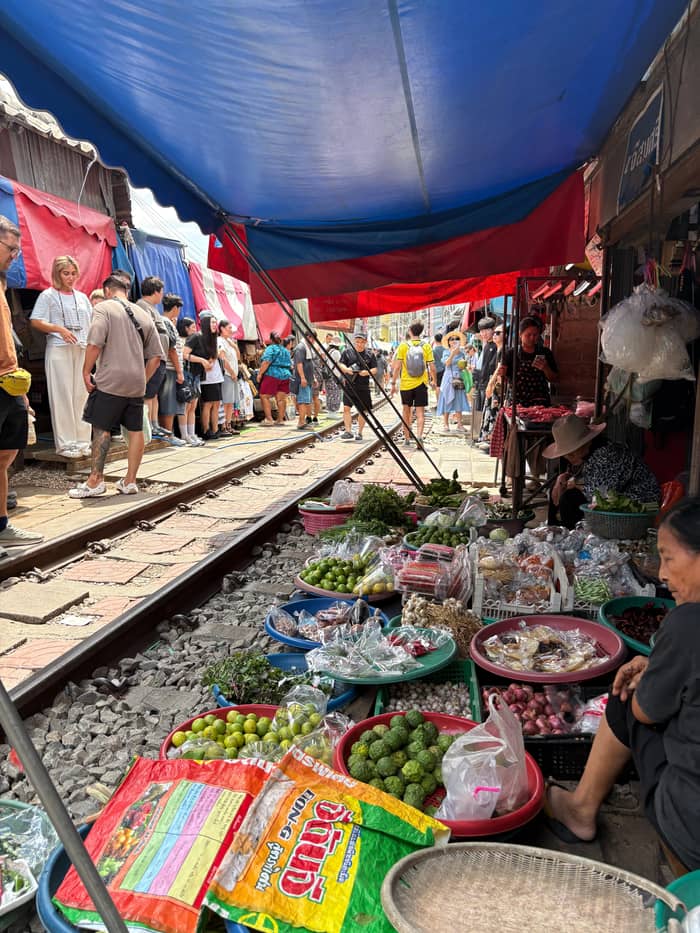
Light
Phone
Simple and quick
- StrengthAlways with you
- LimitShade and zoom
- TipSwitch to video early
Checklist you can tick
Checklist · 9 points
Tick items as you finish them. We save your progress on this device.
0 / 9 ready
All done. Only the date and the number of travellers are left to choose.
Claim a spotThe folding awnings, the slow train and the crates sliding back make a strikingly photogenic minute. Here is where to stand, how to set your camera and what the drone rules mean for an aerial view.
Editorial team, maeklongrailwaymarket.click · Updated November 12, 2026 · Read in 8 min
Essentials
The Maeklong market is built for the camera without trying to be. A strip of colourful awnings, crates of fruit and fish and a train sliding through a gap that closes behind it make a scene that reads immediately, even on a phone. According to the station master, as TAT reports it, the photographers here are mainly European, while Asian and Chinese visitors also like to buy seasonal fruit.1
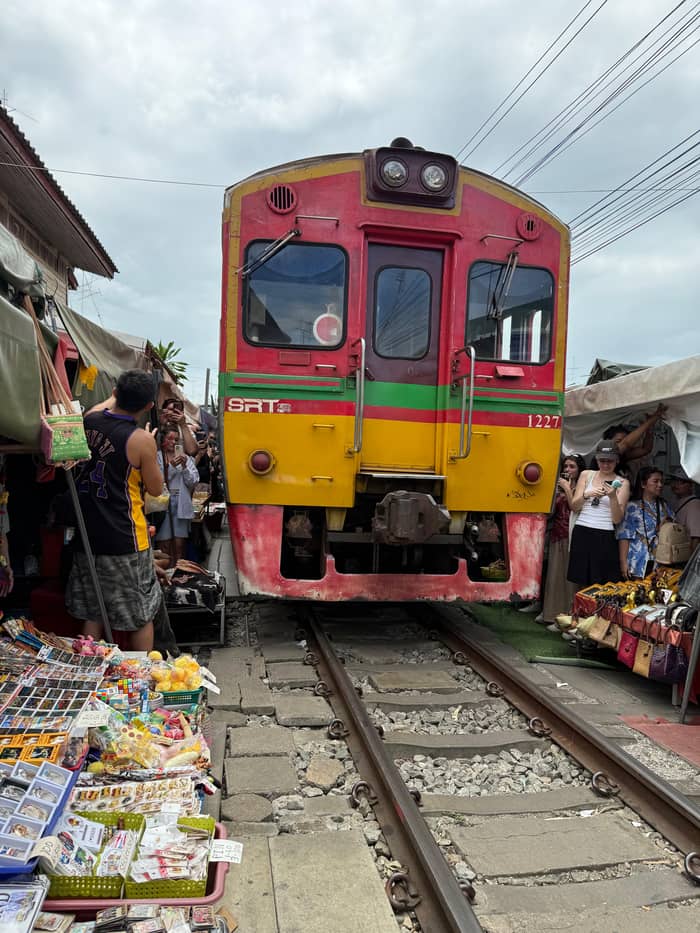
What makes the pictures work is contrast. The stalls are low, busy and close to the ground, and the train is large, slow and rare. You can frame them together, show the moment before and after, or use the folding canopies as a moving frame inside the frame. Every minute offers a different composition, so you can leave with a set rather than a single shot. A low angle exaggerates the scale of the train, while a high angle shows the pattern of the awnings.
It is also a place that rewards patience. Arrive early, walk the line before the train, note where the light falls and where the crowd gathers, and choose your spot. Strong photographs here tend to come from people who watched a pass before they raised the camera, and who knew exactly what the train would do. Bring a small cloth for lenses, as dust and heat find their way into every camera on a day like this.
Shot list
| Shot | Where | Setting tip |
|---|---|---|
| Train arriving | Station end, beside a stall | Burst mode, fast shutter |
| Awnings folding | Mid-market, behind the stalls | Video, steady arms |
| Train leaving | Far end of the line | Continuous focus |
| Stalls reopening | Beside the track | Wide lens, shade |
| Vendor portrait | At a stall, after asking | Natural light |
| Aerial view | A terrace, not a drone | Wide angle |
Spots and settings are practical suggestions. Drone use is governed by the TAT rules summarised here.2,3
The safest and often the strongest spot is beside a stall, a short step from the track, with a vendor and crates behind you. From there the train fills the frame, the awnings fold above it and nobody is blocked. Avoid standing between the rails, and never lean over them for a better angle, since the point of the exercise is to be safe as well as to get the shot. Keep your elbows tucked in and your feet planted so you can step back quickly if the crowd shifts or someone in front of you moves.
A spot at the station end gives you the train arriving head-on, and a spot further along gives you the train moving away with the awnings closing behind it. Both work, and walking between them after a pass is a good way to vary your portfolio. If you are on a tour, ask your guide for the day's usual spot, and keep to the group's time limits. Do not claim a spot with a tripod for a long time, as other visitors want a look at the same view and the vendors need room to work.
Check the background before you commit. A tidy edge of fruit and a clear line of awnings look better than a pile of crates, and a quick look at the light tells you whether to shoot with the sun behind you or to the side. A little thinking ahead saves you a lot of cropping later. Look, too, at what sits behind the awnings, since the shape of a stall can add depth to a picture, and a clear horizon line keeps the composition calm.
A photographer's visit
On arrival
Note the light and the spots before the train comes.
Before the train
Stand beside a stall, clear of the rails.
The train
Capture arrival, the gap and the departure.
Right after
Shoot the canopies rising and the stalls refilling.
Between trains
Buy something small and ask before photographing.
The market is a tricky lighting situation: shaded under the awnings and bright where the sun reaches the track. Use a fast shutter speed to freeze the train and the moving crates, and let the aperture and ISO make up the exposure. Modern cameras and phones cope well, but a quick test shot during the wait tells you what your device does. If your camera has a mode for sports or action, it is a good starting point, and you can fine-tune it after the first test frames.
Switch on continuous focus and burst mode as the train approaches, and shoot a short run rather than a single frame. The train slides in slowly, so the moments you want are the ones with a clear gap and a clear subject. Review a few frames and delete the ones that are soft, so you can focus on composition when the next pass comes. Do not be shy about taking many frames, since the cost of a delete is a lot lower than the cost of missing the pass.
For video of the Maeklong railway market, shoot in landscape, steady your arms against your chest and keep the camera running through the reopening, which is as much a part of the story as the train. Record some ambient sound, the shouts and the clatter, and finish with a slow pan across the stalls. Good clips often come from the moments around the pass. If you use a phone, clean the lens first, lock the exposure on the shade and tap the screen on the stalls to keep the focus steady.
Choose your approach
Match your kit and your patience to a plan.
If I have a phone and little time
Shoot video from the side
A short video clip captures the awnings, the train and the reopening.
If I have a camera and patience
Watch a pass, then shoot
Use burst mode and continuous focus when you know the rhythm.
If I want an aerial view
Skip the drone
If I want portraits
Ask beforehand
A purchase and a smile open doors; a no is a no.
If I am on a tour
Plan your free time
The tour allows free time at the railway market.
Pick your kit
Light
Simple and quick
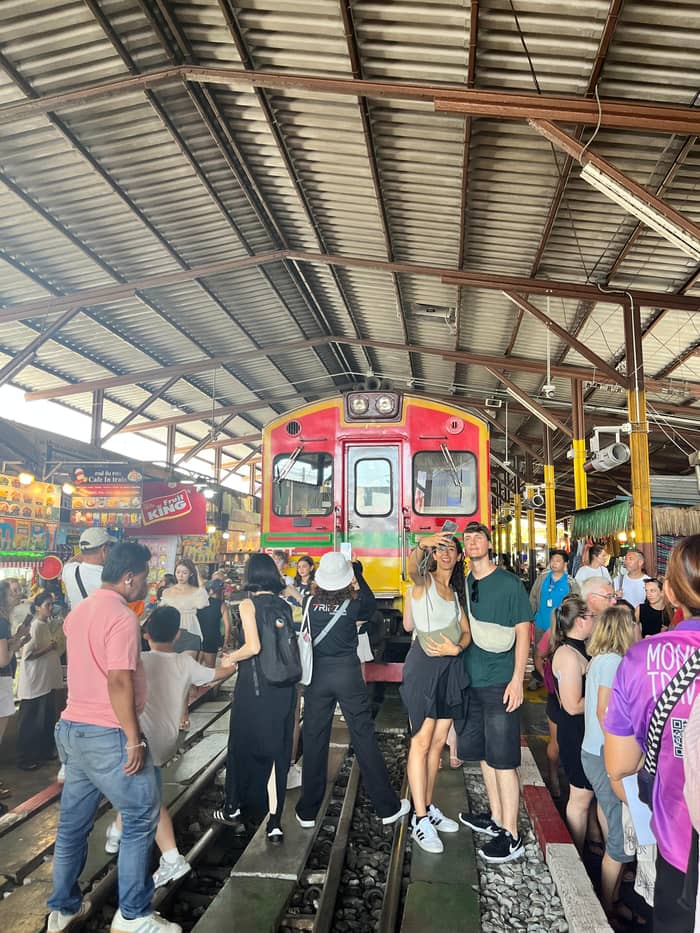
Pro
More control
Rules
Tightly regulated
An aerial view of the Maeklong railway market is a popular idea, and a drone would be the obvious way to get one. In Thailand it is also a legal minefield. TAT's guide says a drone must be registered with NBTC and with CAAT before it can legally fly, and that registering with only one agency is not enough.2 A flight plan must be lodged with CAAT on its online portal no later than three days beforehand.7
The rules for the location are tougher still. TAT says flights over urban areas and gatherings are prohibited unless authorised, flights are limited to daylight and clear weather, with the aircraft kept in sight.3,5 A busy market with a train passing is not a casual place to launch one. That makes a drone at this market a decision for specialists with the paperwork, not for a visitor with a gadget and an afternoon.
The penalties are serious: TAT lists penalties of up to a year in prison, a fine of up to THB 40,000, or both.4 For a visitor the practical choice is to keep the drone in your luggage and look for an elevated spot, such as a cafe terrace or a footbridge, where you can shoot down on the market without flying anything. A cheaper and safer option is to book a table at a high spot and let the camera do the looking.
Shoot it
Set the size of your party and compare the home tour, the train-led day and a private car as bases for a photo trip.
Look at 3 options
Set the size of your party and compare the home tour, the train-led day and a private car as bases for a photo trip.
≈
View≈
View≈
ViewCurrency conversion uses the ECB reference rate on GetYourGuide from-prices. The exact price is displayed when you book.
Vendors are working here, and a camera pointed at their face is an intrusion unless you ask beforehand. A smile, a gesture towards the camera and a nod is usually all the exchange you need. If the answer is no, put the camera down and move on, and if the answer is yes, buy something small as a thank you. Children and elderly vendors deserve extra consideration, and a photograph taken without asking is rarely worth the discomfort.
TAT's etiquette advice for temples is a good guide for the whole trip: most temples permit photographs, yet blocking someone's path for a picture is considered rude, above all when they pray or give an offering.6 The same courtesy applies at the market, where the vendors are going about a daily routine and children and older people may not welcome a lens. Share the sense of a place with your viewers, not just the surface, and keep your lens at a distance that feels comfortable to the people in it.
If you visit nearby temples, follow the dress and shoe rules that TAT sets out, and note TAT's reminder that a monk or his robes must not be touched by a woman.8,9,10 A respectful attitude brings better photographs, since people relax when they see that you are not treating them as scenery. Treat sacred places with the same care that you give a quiet street, and photograph what is allowed rather than what is tempting.
Video
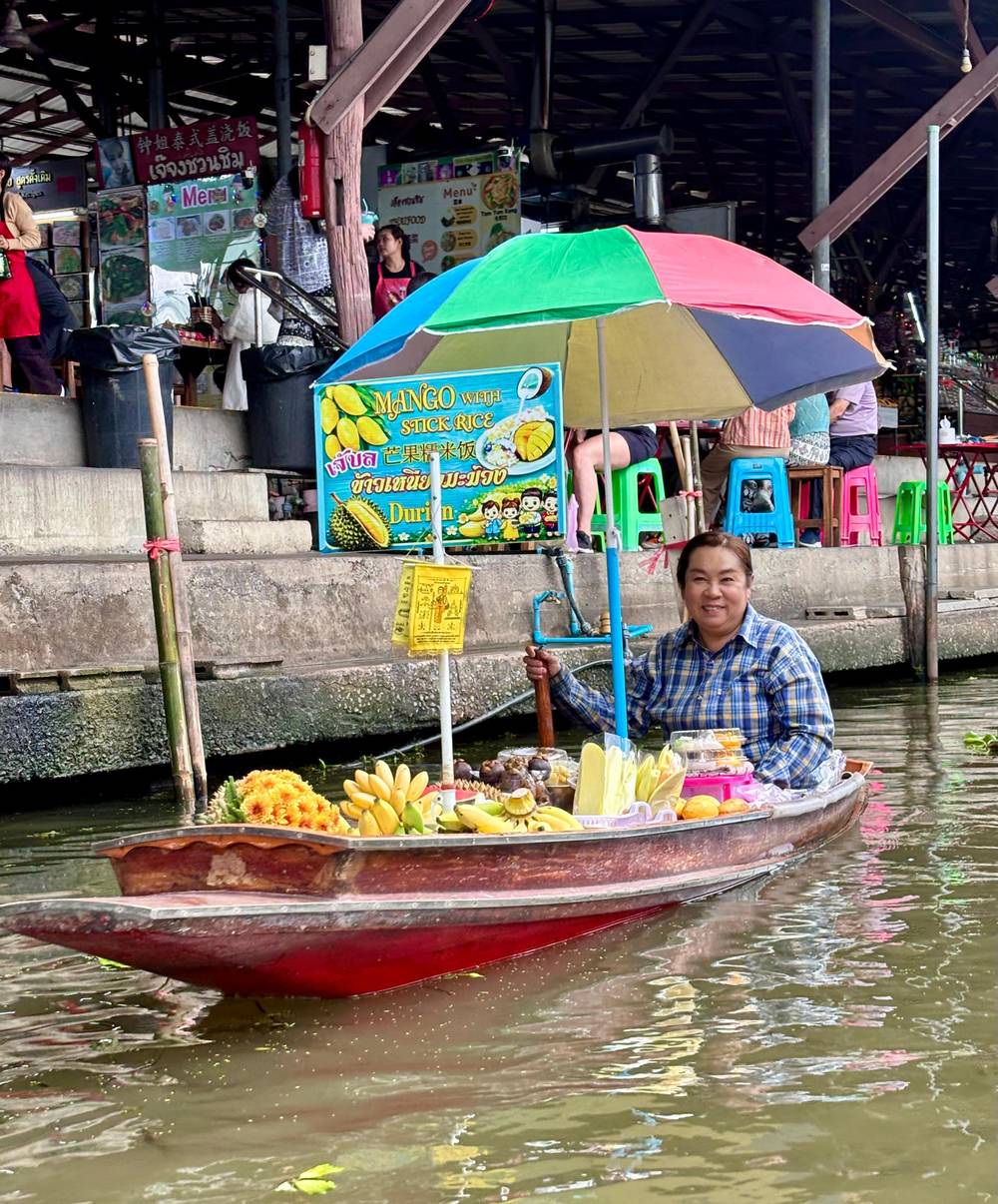
Everywhere Anywhere on YouTube · Your tap on play is what loads the video.
Registration with a single agency alone is insufficient. Both NBTC and CAAT registration are mandatory for the legal operation of drones
On a tour day the schedule decides how long you have. The home tour gives free time at the railway market, and its train ride is part of the day except on the 07:00 AM departure. Decide before you arrive which shot matters to you, and use your free time on that rather than trying to photograph everything. With a shared tour the guide controls the clock, so it pays to know your priorities before the train comes.
If you travel independently you control the clock. Plan to spend long enough to watch the train pass a few times, from different spots and in different light. Keep your gear light, bring a small cloth to wipe lenses, and protect the camera from the dust and the heat with a bag that you can close quickly. Wait for the next pass if the first is not what you wanted, and use the time between trains to scout other spots.
Back at the hotel, sort your photographs while the day is fresh. Pick a handful that tell the story, from the awnings folding to the train passing and the stalls reopening, and delete the rest. The market has a rhythm, and a good set will have the same one. Back up your pictures that evening, since memory cards fail and phones get lost, and share a few with friends while the day is fresh.
FAQ
Stand a short step from the track with a vendor and crates behind you.
TAT says violations are punishable by up to one year in prison, a fine of up to THB 40,000, or both.4
Buy something small and ask before photographing a vendor's face, and accept a no.
TAT reports the station master naming European visitors as the main photographers.1
The home tour allows free time at the Maeklong Railway Market.
Sources
Planning a Maeklong railway market day? Ask a real person here.