Bangkok end
Wongwian Yai
Where the line starts
- RoleBangkok side starts
- NetworkNot linked to main lines
- Visit forThe start of the ride
Look up your stop
See all 19 stops
Pick a route and tap a pin or a stop: you get its note and a Google Maps link.
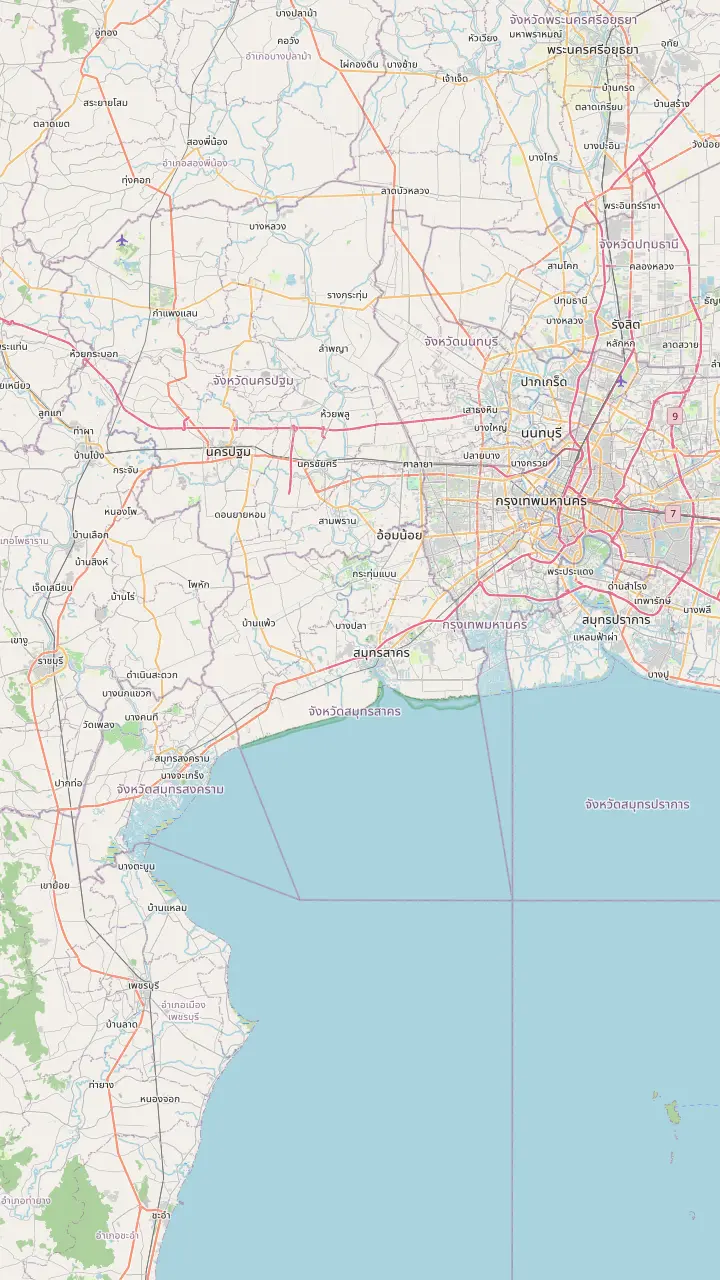
Where the first section of the line starts in Thon Buri.
Google MapsThe station where passengers change trains on the way to Samut Songkhram.
Google MapsThe ferry across the Tha Chin River joins the two sections of the line.
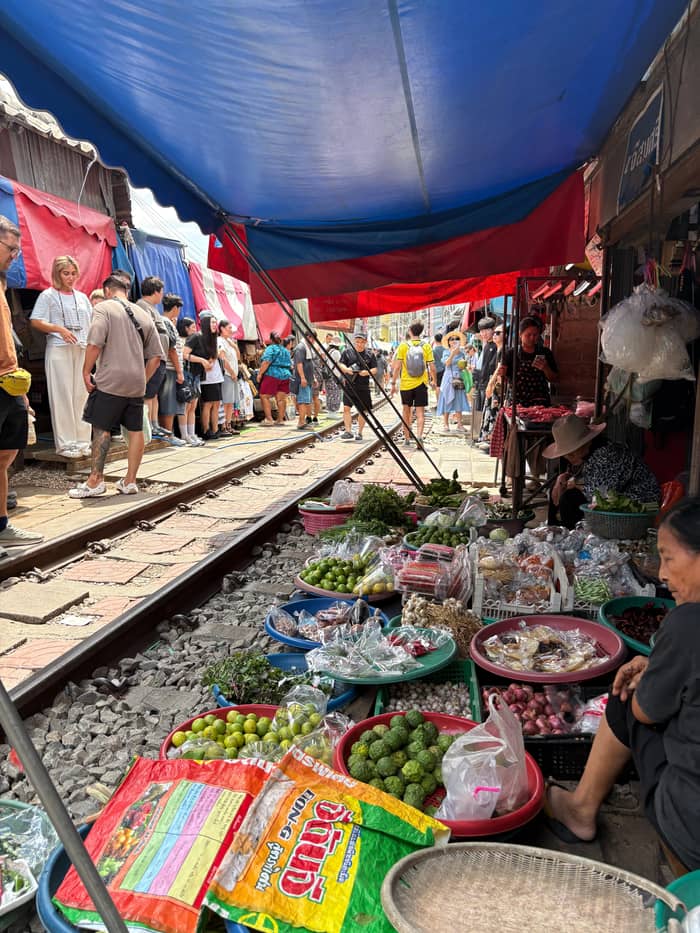
Google MapsThe railway market stands beside Maeklong Railway Station, with fresh and dried food on the stalls.
Google MapsThe bronze Buddha image Luang Phor Wat Ban Laem sits here, the main attraction of Samut Songkhram according to TAT.
Google Maps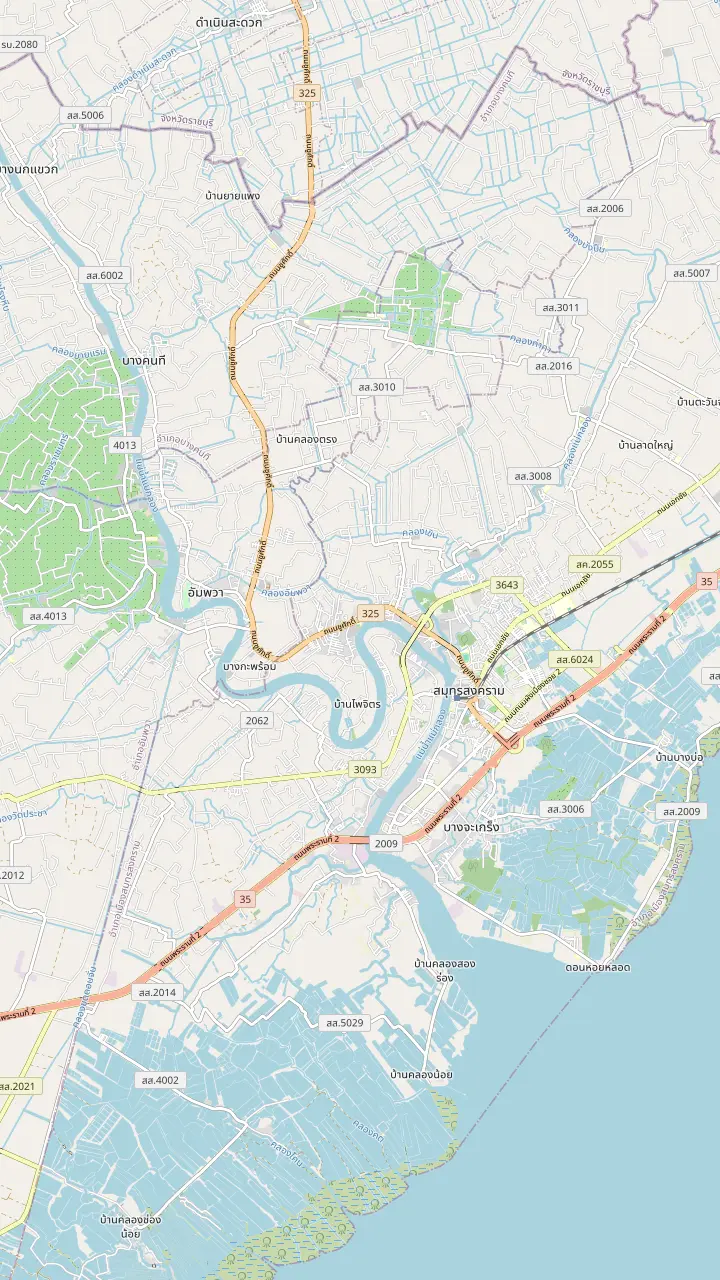
The railway market stands beside Maeklong Railway Station, with fresh and dried food on the stalls.
Google MapsThe bronze Buddha image Luang Phor Wat Ban Laem sits here, the main attraction of Samut Songkhram according to TAT.
Google MapsThe banyan-wrapped temple with murals and Muay Thai statues.
Google MapsA temple with carved wooden panels showing scenes from the life of the Buddha.
Google MapsA sandbar at the river mouth known for fresh and dried seafood.
Google MapsAmphawa is the best known floating market of the province, busy at weekends.
Google MapsA park beside Amphawa that hosts evening programmes and festivals.
Google MapsOne of the other notable floating markets of Samut Songkhram.
Google Maps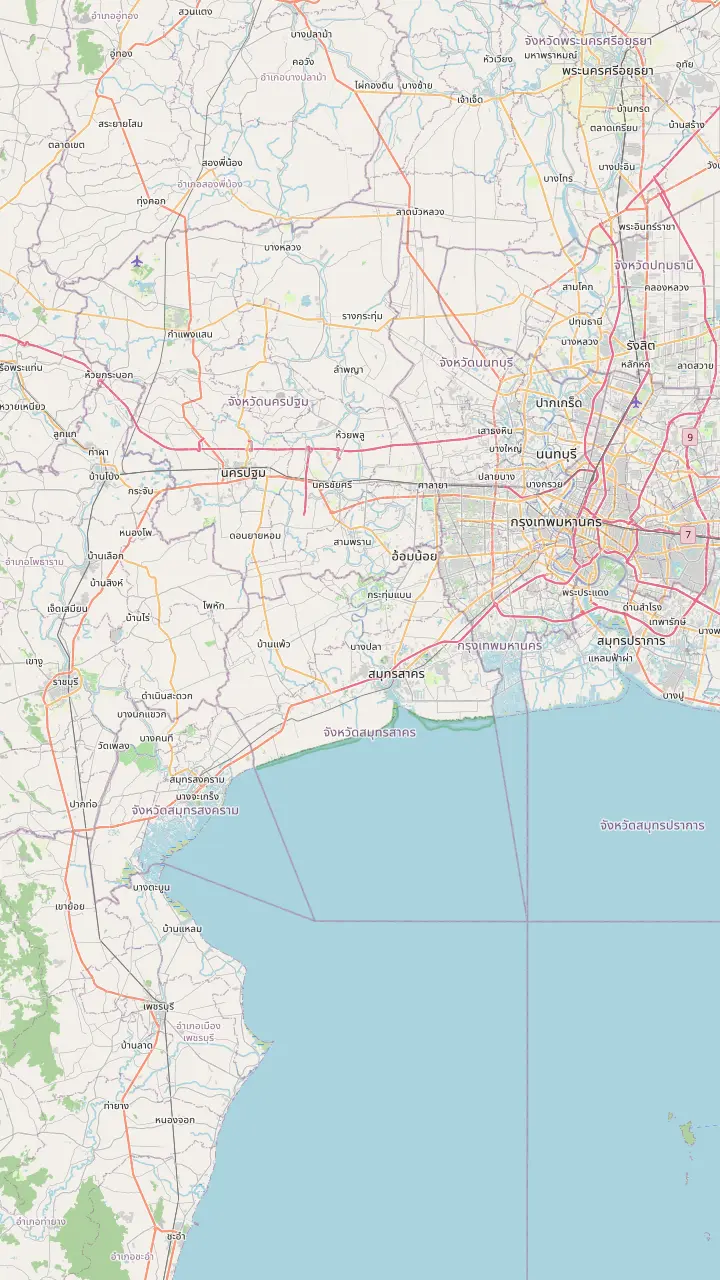
Bangkok's Southern Bus Terminal, where buses and minivans to the west leave from.
Google MapsWhere the first section of the line starts in Thon Buri.
Google MapsThe station where passengers change trains on the way to Samut Songkhram.
Google MapsThe ferry across the Tha Chin River joins the two sections of the line.
Google MapsThe railway market stands beside Maeklong Railway Station, with fresh and dried food on the stalls.
Google MapsThe floating market that the home tour combines with the railway market in one day.
Google MapsMaps © OpenStreetMap contributors
The line began as a private route for the fishing ports, was taken over by the state, and ended up with a market on its track. Here is what the record says, section by section.
Editorial team, maeklongrailwaymarket.click · Updated November 12, 2026 · Read in 8 min
Essentials
Thailand's railways start with a short run. TAT records that trains entered service in 1893 on a line of 21 kilometres from Bangkok to Samut Prakan, and that the State Railway of Thailand now runs a network of over 4,500 kilometres of track.4,5 Against that scale the Mae Klong line is small, but it has a character that the large trunk routes lack, as it never joined them. It is a modest number set beside the national network, yet the line it describes does more than its length suggests.
TAT calls the Thon Buri to Samut Songkhram service a train to nowhere for exactly that reason: the route does not connect with the wider network.6 It is an island of track on the Gulf coast side of the capital, with its own stations, its own rhythm and, at the western end, a market that has taken over the corridor. That isolation is part of why the line feels like a different railway from the one that heads north.
So when searchers type Mae Klong railway they are looking for something that is neither a commuter line nor a long-distance route. It is a short, working, slightly eccentric line whose story is bound up with the coast, the river mouths and the stalls that cluster wherever the rails run through a settlement. That is the character the rest of this page follows, from the line's purpose to the market's growth and the way the two coexist today.
The line in parts
| Part | Where it runs | Notes |
|---|---|---|
| Bangkok side | Wongwian Yai towards Samut Sakhon | Ends before the river |
| The crossing | Tha Chin River by ferry | A boat joins the two halves |
| Far bank | Far bank to the Maeklong market | Ends beside the Mae Klong River |
| Operator | State Railway of Thailand | Began as a private line |
TAT states the founding purpose plainly: a private coastal route that tied the fishing ports to the markets of Bangkok, with the State Railway of Thailand running the 80 km line today.1 That sentence explains the geography. The rails follow the coast: the catch was there, and Bangkok's appetite was at the other end. Read together with the line's route, the sentence is a compact history of the line.
Fish and salt are the logic of the area. TAT lists Samut Songkhram among the salt-producing regions on the Gulf of Thailand near Bangkok, and its documentary route through the province features the mackerel that the waters give up.8,9 A railway that carries perishable seafood needs to be quick and local, and a private coastal line suited that trade far better than a main line far inland.
TAT does not give the year the Mae Klong line opened or the names of its original companies, and this page does not guess them. What the record does support is the direction of travel: private builders, a trade in fish and produce, and later a state operator running the same corridor under the State Railway of Thailand name that appears on every sign today. That restraint is deliberate: a date or a company name without a source would be worse than none.
The line is not one continuous track. In TAT's account the line works as two rail legs with a different train on each. One leaves Wongwian Yai in Thon Buri and stops around the midpoint towards Samut Sakhon, and once a boat has taken passengers over the Tha Chin another train finishes the journey at the Maeklong market beside the Mae Klong River.2 A second TAT description gives the same shape, with a change once in Mahachai.15
The ferry is what makes the Ban Laem railway station matter. It is where the second train starts on the far bank, and it is the platform a traveller reaches after the crossing before the final run into Samut Songkhram. The river was never bridged by the line, which is why the arrangement has the feel of two small railways joined by a boat, and it adds a little adventure to what would otherwise be a simple commute.
The ferry also shapes how you plan a day trip. You cannot ride through without leaving the train, and the crossing sits between two timetables, so a delay on one side can cost you the other. That is worth knowing if you intend to do it by rail rather than on a tour, and it is a reason to take the road route on a first trip and keep the railway for a later visit. Allow slack in the day, check how tickets work for each section, since the two lines are timetabled separately, and keep a note of the last ferry so that the return leg does not leave you stranded on the wrong bank.
Pick your depth
Match your interest to a plan; the rail story rewards a slower trip.
If I only want the famous moment
Join a market tour
The home tour links the railway market with a floating market in a day.
If I like the story of the line
Ride the line by rail
Train, ferry and train show how the line was built in two parts.2
If I want to see the coast it served
Stay a night
TAT says the line also works as an overnight trip.11
If I want local food culture
Add Don Hoi Lot
Seafood stalls line the road on the sandbar at the river mouth.12
If I want temples and old murals
Add Wat Bang Kung
The temple has ancient murals and banyan roots over the building.13,14
Along the line
Bangkok end
Where the line starts
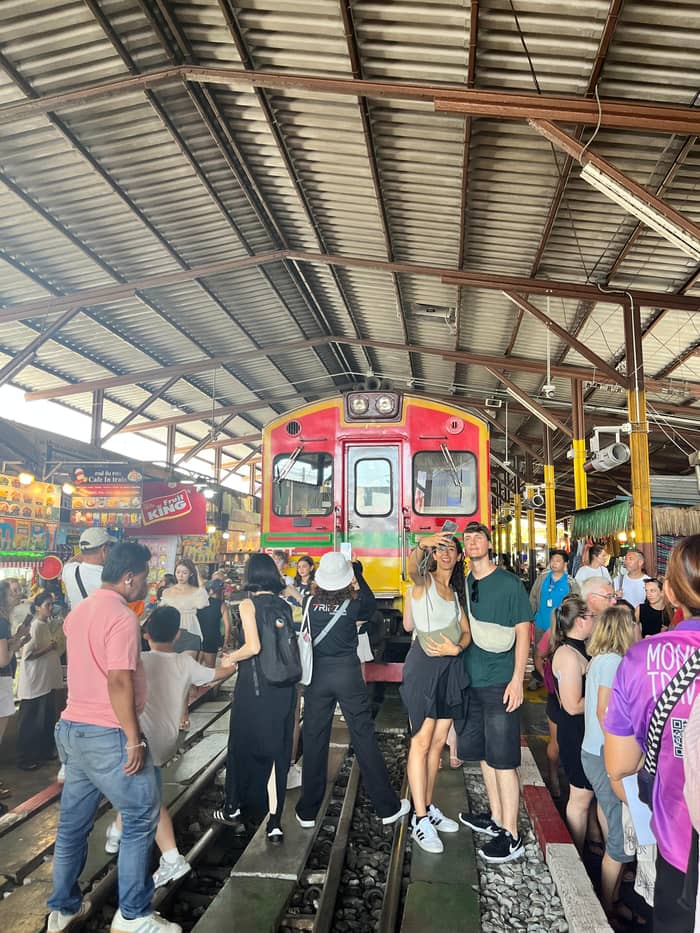
River link
Where the halves meet
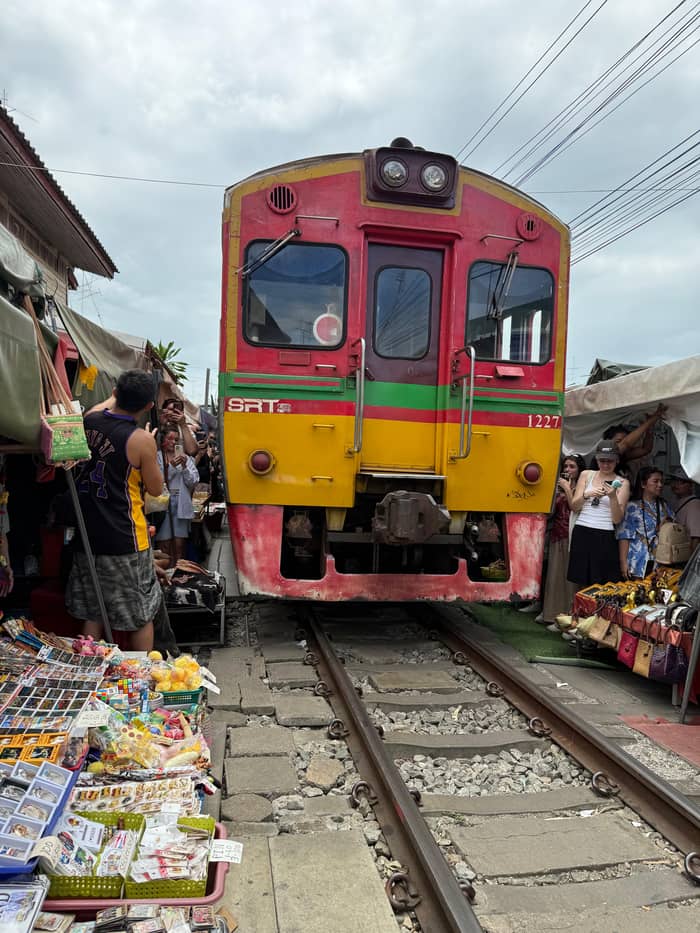
Western end
Where the market is
Markets form where people already pass. Around the Maeklong station the fresh and dried food stalls, seafood included, set up on the doorstep of the trains, and TAT names the result Talat Rom Hup, beside Maeklong Railway Station.16 In April 2018 the Ministry of Interior's spokesperson, quoted by TAT, described the market as part of daily life in Samut Songkhram for 60-70 years.3 The stalls sit close enough to the platform that a passenger stepping off sees the market before the town.
That timescale matters. It puts the market's growth in living memory. People who sold here a generation ago are still sometimes at the stalls, and the habit of folding the awnings for the train has had decades to harden into routine. The same statement counted about 3,000 tourists a day by 2018, a sign that what began as a local necessity has turned into a draw of its own.23 Ask a vendor how long their family has traded here and you may get a story that reaches back through the awnings to the line itself.
The market and the railway have grown up as neighbours rather than partners. A remark from the station master, relayed by TAT, sums up the split: Europeans tend to arrive with cameras, Asian and Chinese visitors with an eye on seasonal fruit, so the station is now as much a sightseeing stop as a transport point.24 That dual role is the modern chapter of a story that started with fish and a private line.
Go and see it
Set the number of travellers and weigh a market day against a private car to see how a visit to the line adds up.
Look at 3 options
Set the number of travellers and weigh a market day against a private car to see how a visit to the line adds up.
≈
View≈
View≈
ViewCurrency conversion uses the ECB reference rate on GetYourGuide from-prices. The exact price is displayed when you book.
What the record shows
Railway age
A line to Samut Prakan opens the railway age.4
Early years
Built to connect fishing ports with Bangkok markets.1
Over time
The State Railway of Thailand now runs the 80 km line.1
Decades on
The market becomes a local way of life of 60-70 years.3
Under scrutiny
The province answers criticism and plans cleaner stalls.7
In 2018 the market was criticised for unsanitary food, and the province answered through the Ministry of Interior.3 The reply, reported by TAT, said the stalls hold raw produce and bagged dry goods rather than meals cooked on the spot, and that anything raw is meant to be rinsed and cooked at home.25,26 The criticism itself was about hygiene, not about the trains, and the answer dealt with it directly rather than defending the picture-postcard view.
The same statement described upkeep: sweeping by the municipality and the station twice weekly, with stallholders tidying their own patches each day.27 Looking ahead, the province planned bilingual signs about litter, extra places to dispose of it and a health-ministry safety standard to steer how the market develops.7 None of this is glamorous, yet it is the machinery that lets a market of this kind keep operating beside a railway line.
For a reader interested in history, this is a useful snapshot of how a traditional market adapts to being a tourist attraction. TAT inspected the market on the day of the statement and found that visitors still came as usual.24 The episode is a reminder that the stalls are a working market first, with rules, cleaning and local politics behind the picture postcard. The pattern is a familiar one for heritage markets: the attention that brings visitors also brings scrutiny, and the stallholders respond with cleaning rotas and clearer rules.
Video
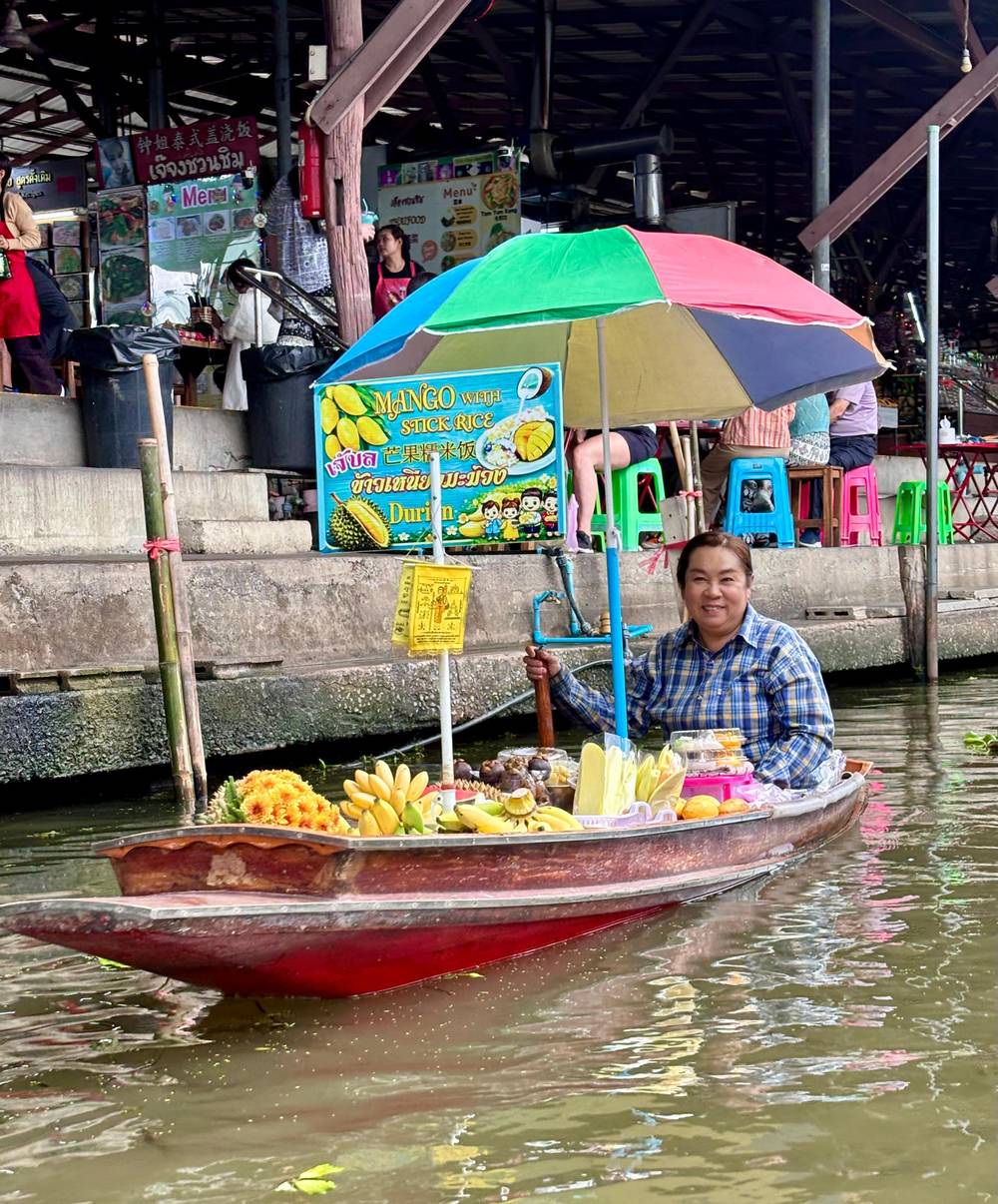
Global Travel Mate on YouTube · Your tap on play is what loads the video.
Built as a private line near the coast to connect the fishing ports with Bangkok markets
Before you go
Today the practical shape is simple. The State Railway of Thailand runs the 80-kilometre line, the ferry joins its two halves, and the market sits at the western terminus where the train still rolls through the stalls.1,2 Tour companies treat the pair of markets as a day out, and our home tour pairs the Maeklong stalls with a Damnoen Saduak canal visit in a single day. It is a combination that works well for a first visit, since the transport is handled and the time at each market is generous.
TAT's alternative is slower: spend a night in the province, and the temples, salt fields and canals come into reach.11 If history is the reason for the trip, the unhurried version is the better one, as the rails make sense when you see the coast and the river they were built for. The pace suits the subject: the line was made for a slow trade, and a slow visit lets you notice the details that a rushed stop skips, from the water to the signs on the stalls.
Whatever route you choose, treat the line as a living piece of heritage rather than a museum. The timetable can change, the market's layout shifts a little from season to season, and a good account of the place is the one you collect on the spot: the vendors' stories, the station staff's tips and the sight of the awnings folding for the train. A guide on a tour is a good source for the oral history, though the figures quoted above are the safest to repeat.
FAQ
TAT says it began as a private coastal line for fishing ports, with no year given.1
TAT gives the length of the line the State Railway runs today as 80 kilometres.1
The Tha Chin River separates them, and passengers cross by ferry between trains.2
The second section begins after the Tha Chin ferry and runs to the market at Maeklong.2
The Ministry of Interior's spokesperson described the market as a way of life of that age.3
The line is separate from the rest of the national rail network.6
Sources
Planning a Maeklong railway market day? Ask a real person here.