On your own
Walk in and wait
Independent, flexible
- CostWalk in at your pace
- TimingYou choose the pass
- SuitsSlow, curious visitors
Checklist you can tick
Checklist · 11 points
Tick items as you finish them. We save your progress on this device.
0 / 11 ready
All done. Only the date and the number of travellers are left to choose.
Claim a spotThe train passing is the reason people come: the awnings fold, the train rolls through the stalls, and the market opens again behind it. Here is how the moment unfolds and where to stand.
Editorial team, maeklongrailwaymarket.click · Updated November 12, 2026 · Read in 8 min
Essentials
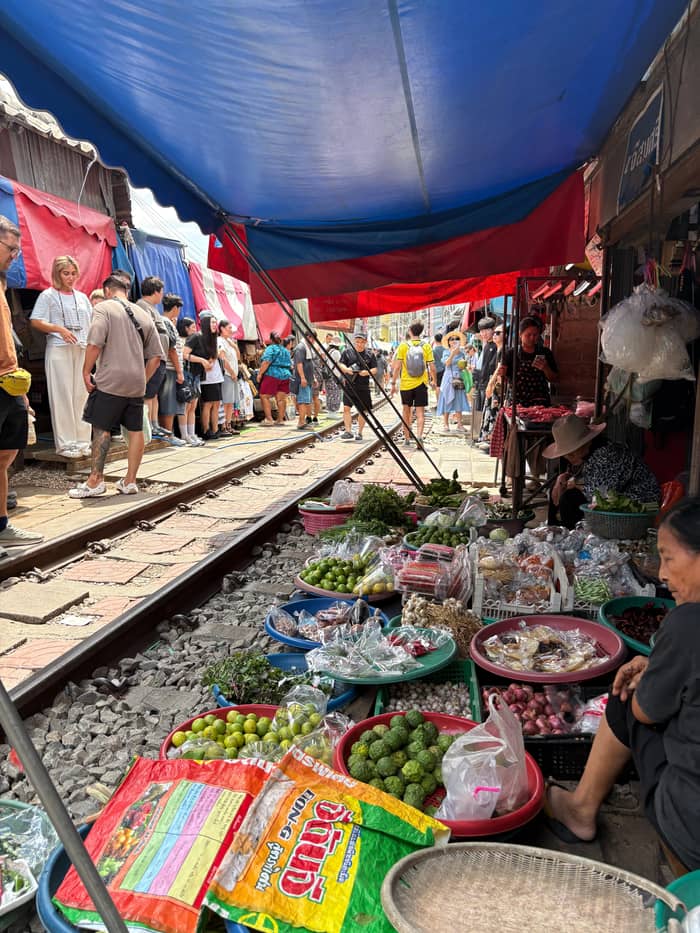
A typical market keeps their aisles clear of anything that moves faster than a trolley. This one sets its stalls right on the sleepers. TAT names it Talat Rom Hup and places it beside Maeklong Railway Station, where the shelves of fresh and dried food, seafood included, run along both sides of the rails.1 Between trains the track is simply part of the shopping floor, and vendors, shoppers and the odd cat treat it that way.
That arrangement is not new. Samut Songkhram's own authorities described the market in 2018 as part of everyday life in the province for 60-70 years, and the same statement counted roughly 3,000 tourists a day coming to watch that trading lifestyle.5,3 The line itself began as a private coastal route for the fishing ports' catch, and it is the State Railway of Thailand that runs it today.2
So the spectacle you queue for is really a collision between routines: a railway timetable and a daily trade that has grown around it. Neither gives way entirely. The stalls hold their spots, the train rolls through, and the people who work here have the choreography down so well that a newcomer mostly notices how calm it looks. The result is a market with a rhythm of its own, slow and loud by turns, and it rewards anyone who arrives early enough to watch the setup before the crowd thickens.
The cycle
| Moment | What you see | What to do |
|---|---|---|
| Before the train | Vendors tidy their front rows | Move to the side of the track |
| Train approaching | Awnings fold, crates slide back | Stay behind the stall line |
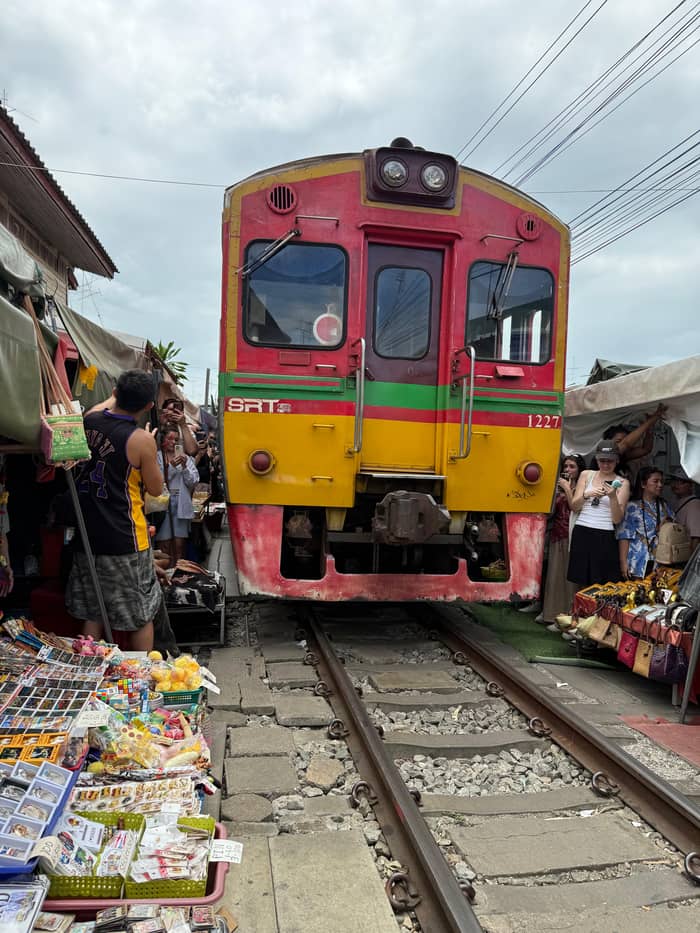
| Train passing | A slow train through a narrow gap | Keep hands and straps in |
| Just after | Canopies go up, stalls reopen | Shop while vendors relax |
| Between trains | A normal busy market | Eat, browse, ask before photos |
The cycle is described from the market's own routine. Fresh food is sold, not cooked meals, as the province stated.8
Rom hup is Thai for lowering the umbrellas, and that is the literal job of the Talad Rom Hub at the moment of truth. The stalls shelter under canvas awnings that reach out over the track. When a train is coming, the awnings are folded or pulled up and the crates are drawn back, which opens a gap just wide enough for a locomotive and its carriages. The effect is easy to picture even if you have never seen it: a long, low roof of canvas that opens along its middle like a zip, then closes again.
The name sticks. The routine is so visible that you remember it. You watch a row of cover disappear in a single sweep, a train slide through where a minute earlier you were looking at tomatoes, and then the canopies go up again as if nothing had happened. TAT's reports on the market keep the Thai name next to the English name: it is the market's identity.7,1 Keep that in mind when you plan photographs, since the strongest frames show the canopies in motion rather than the empty track.
It also explains who comes. The Maeklong station master told TAT that most European tourists arrive with cameras for this unusual market, while Asian and Chinese tourists often like to buy seasonal fruit.6 Both groups are doing the same thing in a different order: watching the train pass, then shopping the moment it is gone. Both habits are worth copying. Photograph before you shop, and your hands stay free for the camera when the train is close.
A visit in order
On arrival
Find the station end and see where the awnings reach the track.1
Before the train
Stand beside the crates, not in the middle of the rails.
The train
Keep still, keep bags close and keep children by the hand.
Right after
The stalls reopen immediately and visitors buy seasonal fruit.6
Between trains
A cafe seat by the track makes the wait easier.
Before the train: the mood changes slowly. Word passes along the row, a few vendors start tidying the front of their stalls, and visitors who have been standing in the middle of the track drift to the sides. If you arrive in time to watch this build, you see the market's own signal system at work, and you will know what to do without being told. It is a good minute to look around, as you can read the whole market's mood from the way people stand.
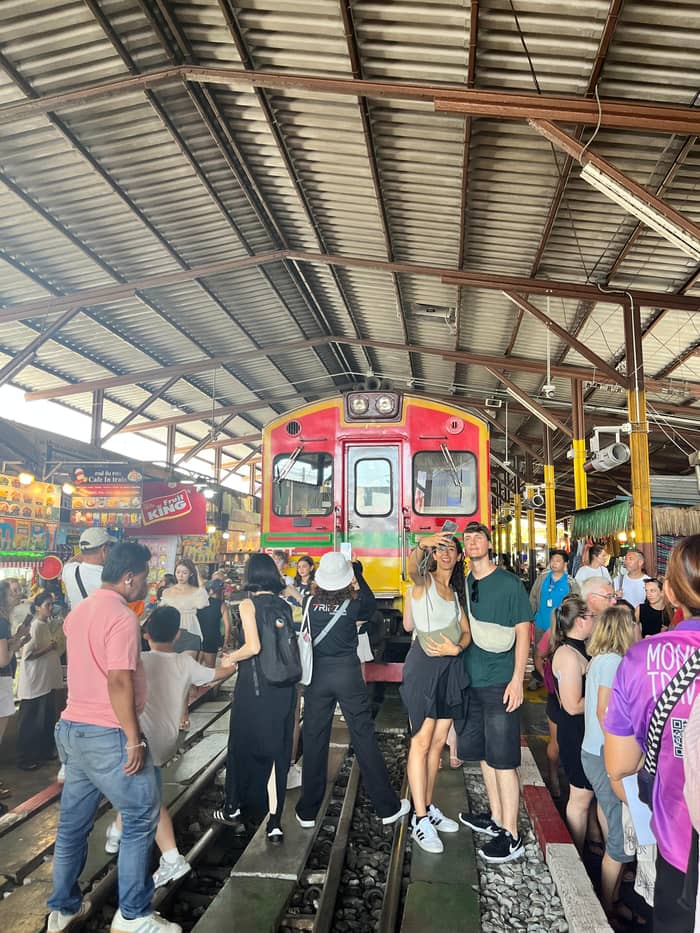
During the pass: the awnings are up, the baskets are pulled back and the train rolls through close to the goods. Stay well clear of the rails and keep your hands, bags and camera straps inside the line of the stalls. If you want a close view, choose a spot behind the vendors' crates rather than in front of them. Resist the urge to step forward for a better angle, since the narrow gap is the whole point and everyone nearby is relying on it staying clear.
After the train: the canopies drop, the crates slide back and the track becomes a shopping lane again within moments. It is a good time to buy: the vendors are relaxed and the crowd is already moving. Expect the same cycle to repeat on the next timetable slot, and give yourself enough slack in the day to catch several if your view is blocked. If you are using a phone, switch to video a few seconds early and keep it running through the reopening, since the reopening belongs to the scene too.
Choose your view
Match the spot to how close you want to be and how much you want to carry.
If I want a strong photo of the train
Behind the stall line
A side spot leaves the track and the vendors' working space free.
If I am with small children
Stay well back
Children and prams belong away from the track, held by an adult.
If I want to sit and watch
A cafe by the track
A seat with a drink saves your legs and gives a steady view.
If I have a long lens or a tripod
The edge of the crowd
Cases and legs can catch a passing carriage, so keep them behind you.
If I have time for a single pass
Go with a tour
The home tour fits the markets to the train schedule.
Ways to watch
On your own
Independent, flexible
Rail trip
The journey as the draw
Tour day
Guide and transport included
Pick your spot before the train is due. A place beside a stall, with the crates and a vendor behind you, is safer and gives a clearer view than the middle of the track, and it keeps you out of the way of the people who actually work here. Walk in from the station end if you can, so you see the market coming alive in the direction the train takes. Arriving a little before the pass also lets you watch where the regulars stand and follow their lead, which is the quickest way to learn the local etiquette.
Do not step onto the rails for a photograph, and do not lean past the line of the awnings. Children and prams belong well back, with an adult holding on, and anyone with a long lens or a tripod should find a spot where legs and cases cannot catch a passing carriage. On a guided day, go by the marker your guide sets, which can change with the size of the group and the crowd. Rest your bag on a stall or the ground away from the track, and keep your eyes on the vendors, who will signal when to move.
If you want to sit while you wait, the cafes along the track sell drinks and a seat with a view, and they save your legs for the shopping afterwards. They are also the places where you can ask the staff how the train usually behaves that day. Stay polite, buy something, and keep your bags on your lap rather than on the track side of the table. Tip the staff by buying a drink, and give up the seat when the train is due if the cafe asks you to step out.
Price the day
Pick your group size and set the home tour against a train-led day and a private car.
Look at 3 options
Pick your group size and set the home tour against a train-led day and a private car.
≈
View≈
View≈
ViewCurrency conversion uses the ECB reference rate on GetYourGuide from-prices. The exact price is displayed when you book.
Whatever the statistics, the safe approach is the same every time. Stay off the rails, watch for the warning as the vendors react to it, and treat their signals as instructions. The market handles trains every day and depends on visitors behaving sensibly around them, which is easy when you have chosen your spot early and left your hurry at the station. A little patience costs nothing, and it keeps the day enjoyable for everyone.
If something does go wrong, including a fall, a lost child or an accident on the tracks, the number to remember is the 24-hour Tourist Police Hotline, 1155, which TAT publishes for visitors.4 Keep it in your phone before you arrive, as mobile signal at a crowded market can be patchy and a search on the spot wastes time. Keep the number written down as well as saved, in case your battery or your signal fails when you need it.
Hygiene belongs in the same conversation. The province's 2018 statement said the stalls carry fresh goods and bagged dry goods with no cooked dishes, that raw goods should be rinsed and cooked first, and that the municipality and the station sweep up twice a week.8,9,10 The practical reading for a visitor is simple: eat cooked food only at places you trust, and wash fruit before you bite. A short break to sit and cool down between trains also stops the heat and the crowds from wearing down your patience.
Video
Friends from Thailand travel guide on YouTube · Your tap on play is what loads the video.
most European tourists would come to take photos of this unique market, while Asian and Chinese tourists would also love to buy seasonal fruits
The train sets the clock, not the guidebook. The home tour on this site says plainly that its market visits can be swapped to adapt to the train schedule, and that its 07:00 AM departure runs without the train ride. Another listing for the same pair of markets starts with the train and ends at the floating market. Whichever way round you book, the order follows what the railway allows that day.
Arrive early at the market side, wander the stalls while you wait, and treat the train as a punctuated event rather than a single moment. People who come with a long gap before the next pass usually enjoy the market more, as the stalls are calmer and the vendors have time to talk, even if you share just a few words in common. Bring a small amount of cash for fruit, drinks and snacks, since small notes make buying quick and polite at a busy stall.
If you would rather ride in on the line itself, TAT's description of the route is the one to follow: a train from Wongwian Yai, a ferry across the Tha Chin River, and another train into the market beside the Mae Klong River.11 Our getting-there page walks through that trip in detail; here the point is that arriving by rail makes the train passing feel like the end of a journey. It is a slower way to arrive, but it turns the passing train from a sight into the conclusion of a trip.
FAQ
TAT uses the Thai name Talat Rom Hup for the market beside Maeklong Railway Station.1
Rom hup means lowering the umbrellas, which is what the stalls do when the train approaches.
Stay off the rails and call 1155 for the tourist police if something goes wrong.4
The listing leaves the train ride out of its 07:00 AM departure.
TAT lists fresh and dried food including seafood at the market beside the station.1
TAT quotes the station master on who turns up with a camera.6
Sources
Planning a Maeklong railway market day? Ask a real person here.